Saturday, January 8, 2011

YAY!!! BOO!!!

By Charles Kessler

Yay: According to DNAinfo.com, New York City is re-designing the Astor Place and Cooper Square area to make it more pedestrian friendly by expanding pedestrian plazas, closing Astor Place between Lafayette Street and Cooper Square to traffic, widening sidewalks and adding seating, trees and plants.

Boo: Jersey City is re-designing Columbus Drive, in the heart of the Historic Downtown, by increasing the number of traffic lanes from an already excessive four lanes to a disastrous SIX lanes of traffic. They plan on doing this by eliminating parking during rush hour (parked cars serve as a buffer for pedestrians making city streets feel safer, and BTW, there are also more pedestrians during rush hour) and narrowing the sidewalks.
Columbus Drive on a quiet Saturday Morning
What happened to the idea of integrating Columbus Drive into the fabric of the rest of the Downtown by installing meridian strips, calming traffic, creating perpendicular parking and making it a retail street?

Jersey City, especially Downtown, is always rated among the top ten most pedestrian friendly cities in the country -- an asset this administration is spending millions to waste. Once again (e.g. The Powerhouse Arts District) Mayor Healy's administration squanders a resource other cities spend millions of dollars to acquire.

Oh, more confirmation of this administration's neglect of pedestrians: while I was out photographing Columbus Drive I nearly killed myself on the sidewalk adjacent to the Grove PATH Station -- one of the most heavily used sidewalks Downtown.

Wednesday, January 5, 2011

Andy Warhol's Silent Film Portraits: a Review of a Review

From the left, the films “Edie Sedgwick,” “Kiss” and “Lou Reed”
Richard Perry/The New York Times
By Charles Kessler


Andy Warhol, POPism, The Warhol Sixties by Andy Warhol and Pat Hackett:
I never liked the idea of picking out certain scenes and pieces of time and putting them together, because it ends up being different from what really happened -- it's just not like life, it seems so corny. ....I only wanted to find great people and let them be themselves and talk about what they usually talked about and I'd film them for a certain length of time and that would be the movie. ...To play the poor little rich girl in the movie, Edie didn't need a script--if she needed a script she wouldn't have been right for the part


I was so disappointed with Ken Johnson’s New York Times review of Andy Warhol's Films, unfortunately one of the only reviews so far, that I thought the best way to write about this show would be to comment [in bold and bracketed] on his review and supplement it with applicable quotes from Warhol and others (in italics).

Here it is:

Who is the fairest of them all? Edie Sedgwick, that’s who, no contest. Of the 13 subjects of the short films known as “Screen Tests”  featured in “Andy Warhol: Motion Pictures” at the Museum of Modern Art, none are loved more by the camera than that doomed “it girl” of the 1960s.

In the mid-60s Warhol made nearly 500 silent, black-and-white films of people mostly sitting still as if for photographic portraits. Some performed and some reacted to off-camera questions and comments. [For the great majority of these films, however, Warhol walked away while the camera ran.

From a Bizarre Magazine interview with Mary Woronov:]
Andy put you on a stool, then puts the camera in front of you. There are lots of people around usually. And then he turns the camera on, and he walks away, and all the people walk away too, but you're standing there in front of this camera.

...The whole purpose is to shoot people for five minutes and see what happens. What invariably happens is somebody either tries to put on a pose, but they end up being more themselves later, they drop everything because the length of time is absurd. Finally, you see the real person behind the facade.

He shot them on 16-millimeter film and showed them slightly slowed down so that they had a languid, meditative mood. (Warhol did not call them screen tests initially; they acquired that label later.) [Significantly Warhol called them “film portraits.”]

In the same period he made his punishingly long, excruciatingly uneventful films “Sleep” (1963), “Kiss” (1963-64) and “Empire” (1964), which will be screened during the run of the exhibition in a specially built small theater.  [Warhol called these films “moving pictures” (pun no doubt intended) and didn’t initially expect people to sit and watch them in a theater for eight hours any more than they’d look at a painting for eight hours. Warhol himself would only stay a few minutes at screenings. Nevertheless, as was typical for Warhol, he went along with it and made boredom a characteristic of his art.

Andy Warhol, POPism:]
I've been quoted as saying "I like boring things." Well I said it and I meant it. But that doesn't mean I'm not bored by them. ...if I'm going to sit and watch the same thing I saw the night before, I don't want it to be essentially the same -- I want it to be exactly the same. Because the more you look at the same thing, the more the meaning goes away, and the better and emptier you feel.
[I think this statement is also relevant to an understanding of his “Death and Disaster” paintings — a topic for another post.]

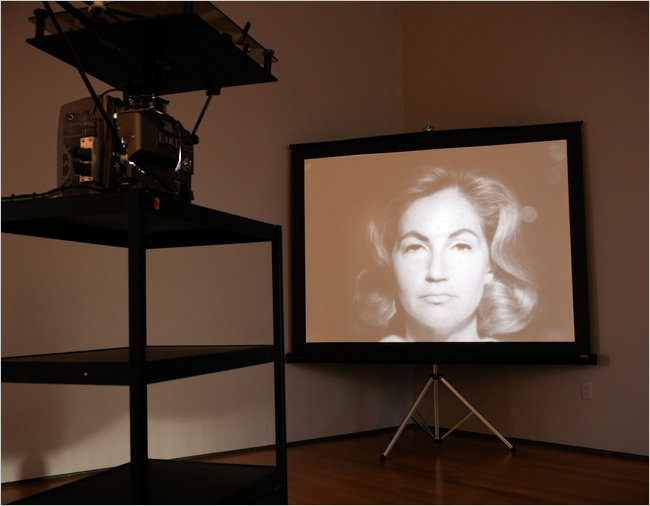
Organized by Klaus Biesenbach, the museum’s chief curator at large, the show presents all but one of these films as digital projections. A portrait of the collector Ethel Scull is presented conventionally, projected on an old-fashioned, portable screen.
“Ethel Scull,” four-minute 16 mm film loop, 1964   Richard Perry/The New York Times
Leaving aside for the moment the questionable practice of digitizing these films, the 13 portraits are fascinating period artifacts. Excepting that of Scull, each four-minute loop is projected above eye-level onto white surfaces framed by black borders in one big room.

Other than that of Sedgwick, each offers more surface than depth.  [Only if you think capturing what people are really like is superficial — but that would eliminate some of the greatest art and literature ever created.] Lou Reed and Allen Ginsberg stare unblinking at the camera as if to defy its attempt to probe their innermost selves. Dennis Hopper knits his brow, looks restlessly this way and that, sings and generally displays the assortment of tics that would become his stock in trade as an actor. [That’s why Warhol hardly ever used professional actors — this reality is more interesting and truer than actors faking unselfconsciousness (or self-consciousness for that matter) or, in the case here of Dennis Hopper, filling the time with his actor shtick.] Paul America chews gum and smirks, evidently in response to off-camera provocations.

[Andy Warhol, Andy Warhol's Index (Book):]
Q:  Why do you let your camera run for the time it runs?
A:  Well, this way I can catch people being themselves instead of setting up a scene and shooting it and letting people act out parts that were written because it's better to act naturally than act like someone else because you really get a better picture of people being themselves instead of trying to act like they're themselves.

Susan Sontag looks like an ordinary, bland young woman of the period. [That’s probably why Warhol almost always used neurotics, addicts and drama queens — they’re more interesting. But even here he accurately captures her personality; he could hardly do otherwise.] Foaming at the mouth as she brushes her teeth, Baby Jane Holzer is neither sexy nor funny. [I thought it was very funny and sexy -- but okay.] With his voluptuous lips, chiseled cheeks and hair over one eyebrow, Gino Piserchio could be auditioning for a role as one of the vain, empty-headed male models in “Zoolander.”

If the singer Nico was charismatic, you would not know it from her portrait, which keeps zooming in for close-ups of her eyes and lips. In contrast the actress Kyoko Kishida, who has an infectious smile, seems fresh and unguarded. [I agree Nico’s isn’t very interesting, maybe because, like Dennis Hopper, she was used to being filmed and admired. Maybe that’s why there’s all this zooming. This film is about beauty so he focuses in on beautiful details.

Andy Warhol, The Philosophy of Andy Warhol:]
I really don't care that much about "Beauties." What I really like are Talkers. To me, good talkers are beautiful because good talk is what I love. The word itself shows why I like Talkers better than Beauties, why I tape more than I film. It's not "talkies." Talkers are doing something. Beauties are being something. Which isn't necessarily bad, it's just that I don't know what it is they're being. It's more fun to be with people who are doing things.
But only Sedgwick’s portrait is transfixing. With her great doe eyes and asymmetrical half smile, she seems hesitant and self-conscious, and that is what makes her portrait so affecting. She is incapable of dissimulating. [But dissimulating is real too.] Neither posing nor projecting; she appears vulnerable, emotionally naked even, and because of that, somehow brave. It is easy to see why Warhol was so infatuated with her. She was the Audrey Hepburn, the Grace Kelly, of the New York demimonde, and it is heartbreaking to see her so young and so full of promise just six years before her death by drug overdose at 28 in 1971.

Warhol’s early films are important because of the way they flout popular movie conventions and lay bare the material facts of cinematic experience. [They did that, but they remain important because of the immediate and effortless way they capture human feeling.] To endure almost an hour of close-ups of different couples kissing in “Kiss,” or eight hours and five minutes of a single, nocturnal view of the Empire State Building (“Empire”) as the office lights progressively go out, or more than five hours of the poet John Giorno sleeping (“Sleep”) would be, in theory, to become painfully hyperalert to the reality of sitting in a dark room in front of light and shadows projected onto a white screen. At best you might enter into a be-here-now state of Zen-like consciousness.

[Andy Warhol, POPism:]
...That had always fascinated me, the way people could sit by a window or on a porch all day and look out and never be bored, but then if they went to a movie or a play, they suddenly objected to being bored. I always felt that a very slow film could be just as interesting as a porch-sit if you thought about it the same way.

In these works Warhol anticipated what would come to be known as Structural Film, which, like Modernist painting, calls attention to the essential properties of the medium. Michael Snow, Douglas Gordon and Sharon Lockhart are just three of countless artists who have mined this vein.

As for digitization, it is an understandable but unsatisfying compromise. As Mr. Biesenbach observes in a MoMA blog post, with 16-millimeter film and projectors an endangered species, it is, for now, the best way to make Warhol’s films widely available. But much is lost in translation. You don’t have to get too close to the projections to see the pixels, which are distracting. [Given that Warhol thought of these films as “moving pictures,” at least initially, this presentation is even better than the original, and it’s likely Warhol would love it. And, BTW, I didn’t notice any pixilation; in fact these digital projections were a lot cleaner than the only film shown -- the one of Ethel Scull.] It is like seeing a movie on television, and that casts in doubt their status as works of art.

Are they authentic artworks, reproductions, documents or some kind of in-between hybrid? With popular movies that focus on plot, character and illusory scenes, it matters less whether we see them as film or digital projections. With Structural Film, truth to the original is more imperative. [Of course they’re reproductions, they’re films for God’s sake. This is such an old and sophomoric criticism that it needs no rebuttal.]

We would not accept a machine-made reproduction as an adequate substitute for a famous painting; a purist justifiably would say the same about film. [What the hell is he talking about? Film makers don’t expect to control what projector is used or how big the projection will be or where their films are shown. And unfortunately they have no control over the condition of the film either.] So here we are between a rock and a hard place. We get to see the films, but once removed and not the way Warhol meant them to be seen. Then again, were he alive today, would he care? Probably not.  [True — probably not. But there is a certain refined, slick, aspect to this presentation that does seem at odds with Warhol’s sensibility.

Andy Warhol, POPism:]
Raw and crude is the way I liked our movies to look, and there's a similarity between the sound of that album (The Velvet Underground) and the texture of Chelsea Girls, which came out of the same time.

“Andy Warhol: Motion Pictures” is on view through March 21 at the Museum of Modern Art; (212) 708-9400, moma.org.

Monday, January 3, 2011

I’ve Been Doing a Lot of Reading Over The Holidays:


By Charles Kessler

Two good (i.e., I agree with them) articles came out today. Roberta Smith criticizes MoMA’s disastrous new space and discusses how it influences the kind of art they can show. (Last year I posted my own criticism of MoMA’s space here.) I don’t, however, agree with her take on the what she refers to as the “glamorously digitalized screen tests by Andy Warhol, minimally organized by the museum’s curator at large, Klaus Biesenbach” -- I’ll be writing about this show soon. And Kyle Chayka on the Hyperallergic blog suggests some “New Year’s Resolutions for the Art World.

Several articles came out in response to The Courtauld Gallery’s “Cezanne’s Card Players” — an exhibition fortunately coming to the Met on February 9th. The always brilliant T. J. Clark has a Marxist interpretation of the work here; and the Telegraph and Guardian weigh in here and here.
Cezanne, The St Petersburg ‘Smoker’ (c.1890-92).
Two posts discuss the use of phone apps in museums. The Brooklyn Museum, in their excellent blog, has a post by the Museum’s Chief of Technology, Shelley Bernstein, explaining what they’re trying to do with their app; and Arianna Huffington writes more generally about the use of technology in museums in The Huffington Post.

The Los Angeles Times has a good critique of plans for a new football stadium in downtown Los Angeles. To their criticisms I'd add that sports stadiums are street life killers and are never a good idea in downtowns. That’s why the area around stadiums are almost always depressed. (Take that, Atlantic Yards.) Another Times article is about an attempt to start an “Art Weekend” downtown as a counter to the popular “party-centric” Art Walk. Good luck.

Finally, don’t miss browsing the Museum of the City of New York’s collection of period New York photographs newly installed on their website.
Jacob A. Riis, Men in a Crowd in a Black and Tan Dive Bar, ca.1890

Saturday, December 18, 2010

Recommended Reading and Some Announcements

Shepard Fairey with Jeffrey Deitch and Fab 5 Freddy at Fairey's exhibition at the Deitch Gallery last May
By Charles Kessler

I never liked Shepard Fairey and this clinches it. The weasel "obeys" his dealer, now LAMOCA Director Jeffery Deitch, and defends the whitewashing over Blu's mural.

Europe Rules That Dan Flavin and Bill Viola Artworks Are Not Art
...the European Commission ruled that installations by Dan Flavin and Bill Viola cannot be classified as "art" by the galleries importing them. Instead of being subject to the five percent VAT (value-added tax) on artworks, such pieces will be taxed at the standard VAT, which will rise to 20 percent in 2011.

I wanted to write something on museums reaching out to visitors, but Gail Gregg says it all in this Art News Article.


Via the always informative Art Newspaper:
When the High Line opens its second segment, known simply as Section 2, in the Spring next year, it will double the length of the public art park. This will “greatly increase the possibilities for artists to work site-specifically,” says Lauren Ross, the curator and director of art programmes for Friends of the High Line.
Some Jersey City announcements:
  • Pro Arts is having its third “Art Eat-Up” event on January 14th, 7-10 pm, Grace Church. For a small donation, there’s a meal, entertainment and you get to vote for proposals that artists submit. All profits go to the winning artists. Past "Eat-Ups" have been real uppers. Go here for details.
  • Also, Pro Arts is looking for a part-time Executive Director. Details are here.
  • Art House Productions will be having their annual "Snow Ball" on January 22nd. This is one of the classiest, most fun events in Jersey City, and it supports an impressive organization. Here are the details.

Wednesday, December 15, 2010

My Two Weeks with Andy Warhol and the Velvet Underground

Not looking happy, from the left: Mary Woronov, Gerard Malanga, John Cale, Sterling Morrison,
Maureen Tucker, Lou Reed, Nico and Andy Warhol, c. 1965, Photograph: Steve Schapiro/Corbis
By Charles Kessler

I was still in the Graduate School of Business at UCLA in 1966, about to transfer to the Art History Department (more on that someday), when I learned Andy Warhol and the Velvet Underground were coming to LA for a two-week gig at The Trip in West Hollywood. It was timed to coincide with Andy’s exhibition of  “Silver Clouds” (mylar pillows filled with helium) at the Ferus Gallery. Unfortunately the helium leaked out during the course of the show and they slowly sunk to the ground. (Beginning December 19th you can see fully inflated ones at MoMA’s new exhibition, Andy Warhol: Motion Pictures.)

I can’t remember exactly how I met Warhol, but it was probably through Kurt von Meier, a zany teacher in the Art History department whom I met that summer through my mentor (and now fellow blogger) Carl Belz. In any case, Andy asked me to show him around Los Angeles, and even though I was a new arrival and didn't even have a car (I got around on a crummy motor scooter that kept falling over), I jumped at the chance. 

It wasn’t as glamorous or as transgressive as one might think. There was a lot of hanging around the kitchen table because the house they rented, a place called The Castle, wasn’t walking distance to anything, and hardly anyone had wheels.  Sterling Morrison borrowed a motorcycle from von Meier and stayed at the Tropicana in the heart of Sunset Strip with a few of the others, but even he would hang out at The Castle.

Here we were, at the height of the era of sex, drugs and Rock ‘n Roll, and as far as I knew there was nothing happening. Andy was asexual, although obviously a voyeur, but except for the show at The Trip there was nothing to even watch. (This was confirmed by Mary Woronov in a 2004 interview.) And as to drug activity, what little that may have taken place was behind closed doors. Andy disapproved of drugs and would even go so far as to hide them from Lou Reed. 

The exciting part was going to The Trip to watch the performance Andy and the others put together — THE EXPLODING PLASTIC INEVITABLE. It was a multimedia event in spades. In addition to deafening music by the Velvet Underground and spectral singing by Nico, there were blinding strobes (in an interview Sterling said they wore sunglasses because of the strobes, not to be cool), a chaotic movie of Warhol’s Factory by Ronald Nameth projected behind the singers and overlaid with multiple slide projections (Andy ran one of them), and an S&M whip dance by Mary Woronov and Gerard Malanga.

It was pandemonium, especially in contrast to the kind of Zen, hippie light shows in California at the time. And it didn’t exactly go over well with the public, who sometimes booed, or with the critics, who wrote things like "The Velvet Underground should go back underground and practice."

Here’s a taste of what it was like; but keep in mind, it was a LOT louder than this video.
Among the celebrities attending opening night were John Phillips of the Mammas and Papas, Ryan O’Neal, Sonny and Cher (Cher left early; she was quoted as saying “It will replace nothing, except maybe suicide” — but Sonny stayed).

Memory is tricky. I could have sworn The Doors opened for the Velvet Underground, but it was Frank Zappa and The Mothers of Invention (Lou hated them and ridiculed Zappa). Jim Morrison, the Doors’ lead (and a recent UCLA graduate), attended the first few concerts and I think was influenced by them, at least to the extent of adopting Gerard Malanga’s tight black leather pants and the Velvet’s droning sound. The Doors were going to open for The Velvets after the third night, but they never got the chance because the Sheriff's Department shut The Trip down for suspected drug use and disturbing the peace. That wouldn’t have bother me — I never liked the Doors much. I thought they were too pretentious. My passion then was Motown — still is. But lucky for me, according to union rules the Velvet Underground had to stay in Los Angeles to be paid, so I got to hang out with them (when I wasn’t busy — I was still a graduate student) for the full two weeks.

Andy wasn’t the easiest person to talk to — he was very shy, and his lack of affect could be disconcerting. He was even more difficult to talk to during this period because he was going around tape recording everything anyone said to him. It’s a little hard to have a conversation with a microphone in your face. (Some of these verbatim transcripts eventually became his “novel,” a, A Novel — a book that makes so-called realistic dialogue seem artificial in comparison.)

Besides Andy I mostly talked to the beautiful, sultry, Mary Woronov. She was an actor in several of Andy’s movies including Chelsea Girls (she also starred in Eating Raoul).  Her role with the Velvets was to do a sexy whip dance with Gerard Malanga ( I only saw him at The Trip). In many ways she was the complete opposite of Nico (aside from both being beautiful): she had a dark complexion, dark brown hair and always wore black, whereas Nico had a pale complexion, blond hair and wore all white clothing; and Mary was a warm, friendly person — not at all the ice queen. (I think I may have been in love!) I also spent time with Paul Morrisey (Warhol's business manager), Maureen “Mo” Tucker (a boyish innocent, and a creative drummer) and guitarist Sterling Morrison when he was around. I hardly ever saw Lou Reed (who spent a lot of the time upstairs stoned) or Nico (who was impossible to have a sane conversation with in any case).

One of the most memorable occasions was a party at the Brentwood home of movie director Mark Robson.  Andy was a great fan of Robson’s movie Peyton Place and was dying to meet him. Via UCLA, I was good friends with two of his daughters, Judy and Martha, and they arranged the party. Again, it wasn’t all that glamorous (although it was the first time I tasted good wine). I don’t think there were movie stars there (not that I can ever recognize them when I see them). No one mentioned seeing any; and it wouldn’t be Mr. Robson’s style in any case. Andy talked to Mr. Robson about Valley of the Dolls, a movie he was working on, and Mr. Robson, who was one of the great Hollywood directors, and a really nice, straightforward guy, kept suggesting kooky ideas for movies. Warhol, in his hesitant, whiny manner, took me aside and told me he didn’t think Mark Robson understood what he did.

The climax of the evening took place when some drunk got belligerent and grabbed Andy. I put my arm between them, and a couple of the Velvets (I don’t remember who) pushed the guy into a chair and stood over him. Andy whimpered to me “I don’t like this party. Can we go somewhere else?” So we left.

The other indelible memory was our trip to, of all places, Disneyland. We all piled into a van and drove to Anaheim (about an hour away). The main topic during the trip was if we’d be allowed in because Disneyland had just refused entry to some famous person who didn’t comply with their strict dress code. The Velvets were convinced that their long hair and black New York clothing would exclude them. I really think they were disappointed when they got in — until, that is, they actually went inside. Then all the bored, sophisticated pretense of Sunset Strip went by the wayside. They were really excited by the place.
The Matterhorn, Disneyland, Anaheim California

Paul handed out money to everybody, including me, for food and rides. I made the mistake of going on the Matterhorn (sort of a tame roller coaster ride) with “the boys” who sang the Mickey Mouse Song at the top of their lungs while trying to tip the car off the rail. Andy didn’t go on any of the rides. I think he was (justifiably) afraid. He’d find some place to sit, drink orange juice (he must have lived on orange juice; I never saw him consume anything else) and watch us. It was like dad (or “Father” in the sense of a priest) watching his flock of twenty-somethings having fun at Disneyland.

I didn't realize then how rare this opportunity was; I was excited, but I guess I sort of thought this would be a common thing for me and not such a big deal. I know better now.
 

Charles Kessler is an artist and writer based in Jersey City

Tuesday, December 14, 2010

The Architecture of Color “Modern Life: Edward Hopper and His Time” Whitney Museum of American Art

Edward Hopper, The Barber Shop, 1931, (Neuberger Museum of Art)
By Kyle Gallup

The faceless, gold-rimmed clock hangs silently on the wall of the shop. A manicurist leafs through a magazine awaiting her next client. A smooth, aqua-glass table holds the instruments of her trade. The barber in his white jacket, back to us, cuts the hair of a customer. His featureless reflection is muted, a fuzzy oval in the mirror. The painting offers us a momentary look inside one of the city’s many barbershops, and we become observers of the placid scene.

A harsh light shines through the window throwing the interior into a bright white, casting cool purple shadows into the imagined space. Is it the midday sun shining in the window, or is it perhaps early morning? Peering outside, the buildings on the street are dark, showing only the slightest punctuation of windows in their facades. A solid, yellow curtain on the window holds back darkness outside. The stair banister of acid yellow-green heats up the interior. Its ornate scrolled metal, transparently painted in tones of brown and purple, angles into the shop, echoing the purple shadow cast into the room by the outside light. The light and shadow—cool and warm, bright white to dark tonalities—color the painting vividly. Edward Hopper uses the architecture of color to create an atmosphere we enter as viewers of his paintings.

Color is the dominant character in Hopper's work and it's what leads me into his world of cityscapes and small town life. Color and light inventively structure his scenes. They reveal solidity of form while creating ambiance and abstract relationships suggestive of time and place without making specific reference to it.

Edward Hopper’s work has long captured America’s imagination. His paintings have become iconic and he is, in popular culture, the painter of the Everyman. The idea that Hopper painted loneliness and alienation as the human condition has practically become a cliché. However, I believe this idea is actually outside the realm of what he thought or cared about. His interest and attention were in the color and light, geometry and space, making order in a rapidly changing world; a nineteenth century boy in a twentieth century world.

As a young man (b.1882) Edward Hopper lived in Paris. He visited museums and made drawings and paintings around the city. He was very interested in Degas’ work. Hopper took from Degas the idea that he could use intimacy as a way for the viewer to enter a painting, though he executed it differently. While Degas was the master observer with an eye for intimate moments with his subjects—the many sensitive drawings and paintings of ballet dancers and the pastel drawings of women in the bath, for instance—Hopper forges an intimate bond between the viewer of his paintings and himself. He paints his figures simply. Yet, their purpose within the composition is abstract and connected to his formal concerns. The figures go about their mundane tasks and do not have the monumentality that the buildings and urban scenes around them express.

The bond of intimacy with the viewer Hopper creates allows us into his world. He wants us to glimpse what he sees. When we look at his paintings we become a voyeur like the painter himself. Hopper exploits his figures, whether it’s seeing the naked pastiness of their skin through an apartment window or watching them go about the humdrum existence in which they are caught. His paintings are cool and lack human warmth—they remain emotionally remote. His figures are mannequins, lonely placeholders in a formal, finely orchestrated world. It is Hopper’s color that continually gives his paintings fullness and connects us to the inner workings of his private world.


Kyle Gallup is an artist who works in collage and watercolor.

Saturday, December 11, 2010

Curatorial Flashbacks #10: Disasters Averted, Mostly (Part 2)

By Carl Belz

Incident: I was called to the office of acting president Stuart Altman at the start of the 1990-91 academic year and told that $120K would be cut from the museum’s budget during the next two fiscal years. The goal was a museum that would not financially encumber the university, funding degree zero. On hearing that, I pretty much went into shock. What the bulk of that $120K consisted of, you see, was the payroll for the museum’s entire professional staff—curator, registrar, membership and events coordinator, and preparator. Fortunately, the directorship had recently been endowed, but wherever would we each year get $120K to keep the place going into the future? Through membership and occasional grants, we were already paying our own way for all of the exhibitions we mounted and the attendant catalogs we published, not to mention the lecture series and other special events that we additionally sponsored. The endowed Rose Purchase Fund enabled us to pursue acquisitions without cost to the university, while expenses for building maintenance were annually covered by yet another endowment that Vice President David Steinberg and I had established back in the late 1970s. Further developmental efforts—to the tune of $120K per year—seemed beyond our reach. Ironically, at the moment when we were close to becoming “a tub on its own bottom”—alas, David Steinberg, long our shield against capricious administration mischief, had left Brandeis in the early 1980s—it was suddenly not inconceivable that we might have to close our doors. Having come to believe that only endowment could secure the museum against future administrative indignities, I determined to build ours, and I elected to do so via deaccessioning.    

We’d done some deaccessioning before, back in the late 1970s when we sold at auction about 15 Old Master pictures, the majority of which turned out to be not Old Masters but rather “followers of” and “students of” and “circles of” Old Masters. We did this in the process of focusing on the modern as our institutional mission, and we did it with the consent of the university administration and after contacting, to the extent we were able, the donors of the pictures, a number of which had come to the university prior to the building of the Rose Art Museum. Per negotiation with the university, proceeds from the sale went into a growing endowment targeted for the museum’s general operation, and that was that. Accordingly, we followed the same procedure in 1990-91 when we deaccessioned and assigned to auction 13 late 19th and early 20th century pictures, including examples by Renoir, Degas, Bonnard and Vuillard. In doing so, we were increasingly identifying the Rose mission as being synonymous with the post-World War II founding of Brandeis University itself.

Outcome: By 1991, however, the cultural climate had shifted. We’d witnessed a decade’s worth of an upwardly spiraling art market so wild that it reminded some economists of tulip mania in the 1630s—a popular candidate for status as the world’s first investment bubble—and in turn alarmed veteran art observers with the thought that works of art were becoming mere speculative commodities. Among museum professionals, there spread concern that some institutions might start selling artworks just to meet their day-to-day expenses—as if they were corporate entities concerned only with the bottom line instead of with the public trust. The most audible voice in articulating that concern was the voice of the AAMD—the Association of Art Museum Directors—and its message was clear: Proceeds accruing from the deaccession and sale of works of art can only be used to make new acquisitions.

I don’t know what the AAMD is like now, but back in 1991 it was like an elite club of individuals representing our country’s wealthiest and most distinguished institutions. It was not, however, an association that just any art museum director could join—as I learned when I naively wrote to them saying I wanted to be a member. You had to apply for acceptance, and to apply for acceptance you had to have an institutional budget of at least $1M a year. I repeat, $1 million! Which left the Rose Art Museum, with its total budget of about half a million dollars at most, on the outside looking in. But which didn’t mean we weren’t on the AAMD’s radar screen. Far from it, as we learned when we were informed after its annual summer meeting in 1991 that the AAMD members, upon learning of our forthcoming sale—it was by no means a secret—had voted unanimously to sanction the Rose Art Museum. Which meant that the institutions they represented would to the Rose neither a borrower nor a lender be, which in turn left us in cultural limbo, adrift, without rank in the professional community with which we were identified. It was a bitter pill to swallow at the moment when we were trying to keep the museum alive, particularly as it came from a group we were prohibited from joining—and not for reasons having to do with our record of achievement, but because of a hoary caste system based on wealth. 

Limbo was not a fun place to be. I didn’t like it. My RAM teammates didn’t like it. Brandeis’s new president, Dr. Samuel Thier—who’d arrived on campus about the time the sanction had been imposed—didn’t like it. And by all accounts, the AAMD didn’t like it either. But with President Thier guiding the process, a compromise was agreed upon, to wit: Brandeis could determine the use of funds resulting from the sale of artworks given to the university prior to the establishment of the Rose Art Museum in 1961, while funds resulting from the sale of artworks given after the establishment of the museum would be used only for further acquisitions.

The auction took place in November 1991 and 12 of the 13 pictures sold, yielding approximately $3 million, which broke down as follows: $1 million went into the acquisitions endowment; $1 million went to an educational endowment requested by the donors of one of the pictures and agreed to by the president; and $1 million was used to establish a conservation and collections care endowment, which, when viewed properly through a creative lens, enabled me to ease steadily the $120K burden originally imposed by the interim administration’s budget cut, the one that precipitated this entire saga and all the discomfort that went with it. I sometimes think about that discomfort and the sagging morale it generated around the Rose in the months prior to the incident’s resolution, and I’m still briefly saddened when I do.

But then I also think about how Rose director Michael Rush must have felt on January 26, 2009 when he woke up and heard president Jahuda Reinharz announce that Brandeis had decided to close the museum and sell the permanent collection to compensate for the huge downturn in the university’s financial resources. Now there’s an incident that could not only sadden, it could actually break your heart. It did mine.


Carl Belz is Director Emeritus of the Rose Art Museum, Brandeis University. 

Friday, December 10, 2010

Recommended Reading

Jacob Jordaens, The-Four-Evangelists, ca. 1625-30, oil on canvas, Louvre
ARTINFO.com has a couple of informative posts today.
More Picassos discovered -- it's become even more complicated:
MOUANS-SARTOUX, France— As a French art crime squad continues to investigate the provenance of the 271 works by Picasso that Pierre Le Guennec, the artist's former electrician, has claimed were gifts, another trove of Picassos has also made the news. The artist is said to have given several works to his chauffeur, Maurice Bresnu, who in 1991 bequeathed the collection to his widow, Jacqueline Bresnu. Following her death in 2009, the works were scheduled to be auctioned by Drouot today, but the heirs unexpectedly decided to postpone the sale without explaining why. Now, Pierre Le Guennec has revealed that Jacqueline Bresnu is a cousin and that he and his wife Danièle are among those who will inherit this new cache of Picassos.
They also have an excellent up-to-date summary of the Wojnarowicz video censorship controversy at the National Portrait Gallery.

Steven Colbert defends the removal of the video, saying that the decision was "based on the finest aesthetic criteria — Republicans threatened their funding." And while you're at it, watch his show with Steve Martin, Frank Stella, Shepard Fairey and Andres Serrano.
 
Blu’s MOCA mural being whitewashed (via Unurth, images by Casey Caplowe)

Another potential censorship controversy MAY be taking place at Jeffrey Deitch's Museum of Contemporary Art, Los Angeles. Deitch commissioned street artist Blu to paint a mural on the walls of the museum and on December 9th it was whitewashed over. Some think it's a Deitch publicity stunt -- a definitely possibility. For current information on this, go to  MSN's Good Magazine.

Mithila Painting

Ranti Women's Art Coop
By Charles Kessler

There’s a kind of art that has characteristics of folk art, tribal art, tourist art and fine art.  It’s sometimes called “vernacular” art, but that implies the artists are untrained and that’s not the case, unless they mean untrained in the Western Fine Art Tradition. It’s highly sophisticated work within its own realm in that practitioners learn from each other, compete with each other, and evolve as artists within their own tradition with minimal significant outside influence. The art is usually encouraged and promoted by the government or not-for-profits, and a lot of it is bought by tourists, but the best work is sought by sophisticated collectors and shown in major art galleries and museums.  Examples include Gee’s Bend quilts, Australian Aboriginal bark painting, and Mithila Painting -- work which can be seen until December 13th at Pingry, a prominent private school in New Jersey.

The name Mithila (also known as Madhubani art for the large city in the region) refers to a style of Hindu art in the north-eastern region of India and parts of Nepal. It began at least as long ago as the 14th century with women painting gods and goddesses and images of fertility on the walls of their homes in order to bring blessings on marriages and other important life events. The work moved from walls to paper in the 1960’s when the government encouraged the women (and now a few men) to earn extra money by making paintings on paper. Soon the subject matter expanded from religious symbolism to depictions of local deities, and now to domestic life and even feminist and other political subjects like this:
Shalini Kumari, Women Do It All, 2005, paint on paper (collection of the Ethnic Arts Foundation)
The paintings are done without preparatory sketches, and are begun with a framing border of ornamental geometric or floral designs that reflect the subject of the painting. The main subject is in the center and the painting is worked out toward the framing border. Embellishing details are then added, and, the last thing, the eyes are filled in to bring the painting to life. 
Swati Kashyap, Women Grinding Corn, 2007, paint on paper
Bharti Kumari, bin Laden Rules the World, 2009
David Szanton, an anthropologist based in Berkeley, has been the main force in researching, preserving and promoting this art through his foundation, the Ethnic Arts Foundation (where you can find all you want to know about this work). To quote from their mission statement, the Foundation: purchases paintings directly from scores of painters, then organizes or co-sponsors exhibitions and sales to individuals, collectors, and museums. Profits from sales are then returned to the artists, in effect providing a double payment for their work. The Foundation also supports the Mithila Art Institute, a free school that trains young people, mostly women, in the art form.

Locally, Peter Zirnis (pzirnis@hotmail.com) is helping to sell their work.  The larger works (30" x 40") are $300 and the smaller works (5.25" x 7.25") are only $40 (although at present they are sold out) ALL PROFITS ARE RETURNED TO THE ARTISTS. Here are some examples of the smaller paintings:
Mamka Karn, Nandi (Shiva's Bull), 2010, paint on paper
Sharda, Tree with Pond, 2010, paint on paper